
A bumblebee lands on a flower, grips it with its feet and pushes its head into the bloom. Sometimes it leaves almost immediately. Sometimes it works its way round, attending to parts of the flower that we had hardly noticed.
We tend to call all of this pollinating. From the bee’s side, much of it is finding food. Both descriptions can be true of the same visit, although they leave us with a question. Does the bee know anything about what happens to the flower?
To follow that question, we can begin with what the bee takes away. Some of its cargo will feed a colony. Some may reach another flower.
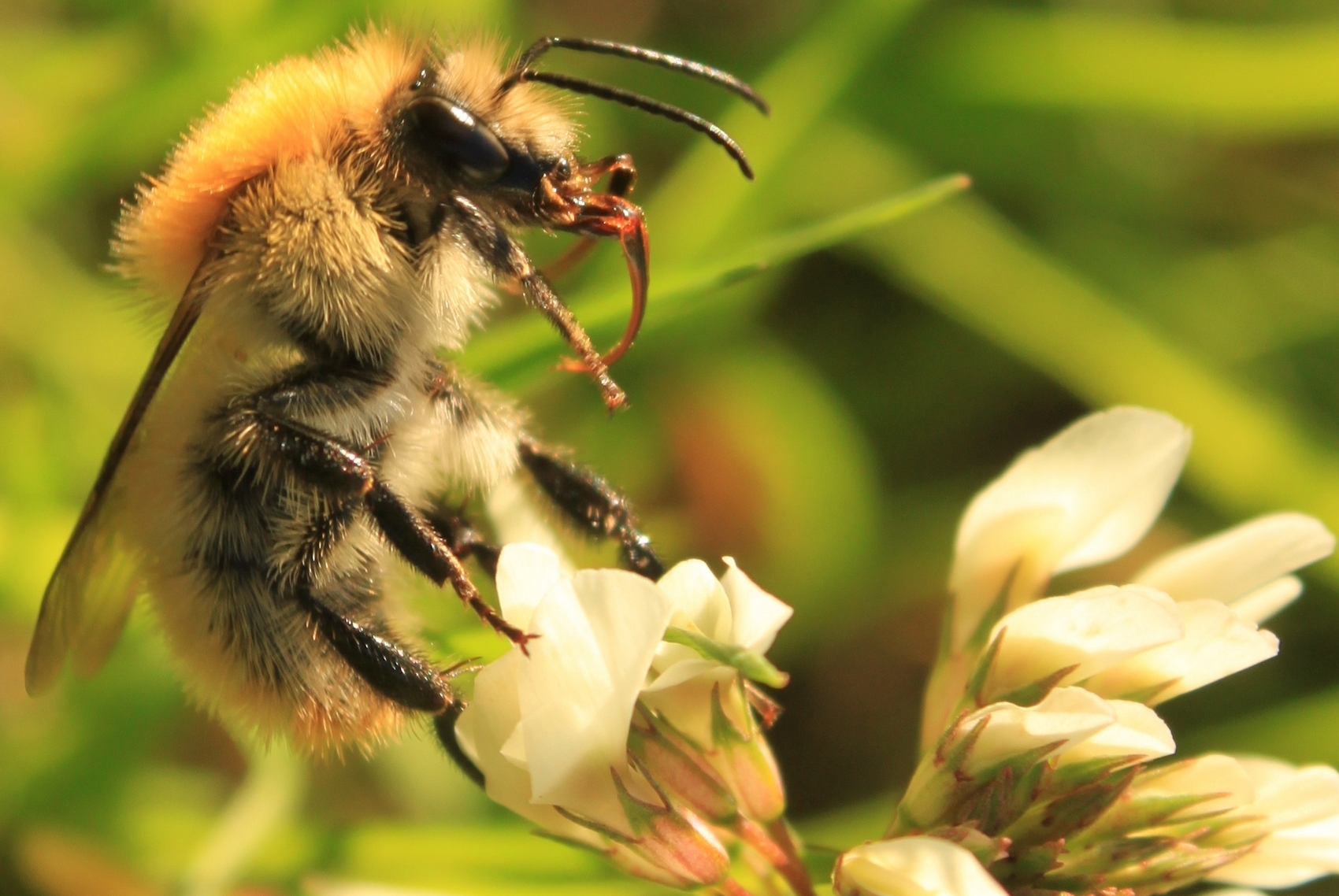
What goes home from a flower
Nectar and pollen are different foods, carried in different ways. Nectar is a sugary liquid that supplies energy. Pollen provides protein and other nutrients and is especially important to growing larvae. A worker may be collecting nectar, pollen or both during her visits. [7]
Nectar is taken up through the mouthparts. Some is used by the bee herself; nectar being carried home travels internally in a storage part of the digestive system often called the crop. That is why a bee can leave with a substantial delivery and show us very little of it. At the nest, nectar can be deposited in wax pots. [4]
Pollen is easier to notice. A pollen-collecting worker or queen grooms grains from her body and packs them into specialised areas on her hind legs, the pollen baskets or corbiculae. The loads can look like little bulging parcels. They are exposed loads held on the legs, rather than sacs filled inside the body. [8, 9]
The conspicuous lumps are food being carried away. Loose grains elsewhere on the bee can have a different destination. Some may be brushed off onto another flower. Keeping those two sorts of pollen in mind helps make sense of almost everything that follows: the packed provision for the nest, and the loose grains travelling on the bee’s body. [9]
An empty basket does not tell us that a bee has done nothing useful. It may be collecting nectar, may only just have begun gathering pollen, or may belong to a sex or kind of bumblebee that does not make pollen loads. We have arrived in the middle of its day. [2, 6]
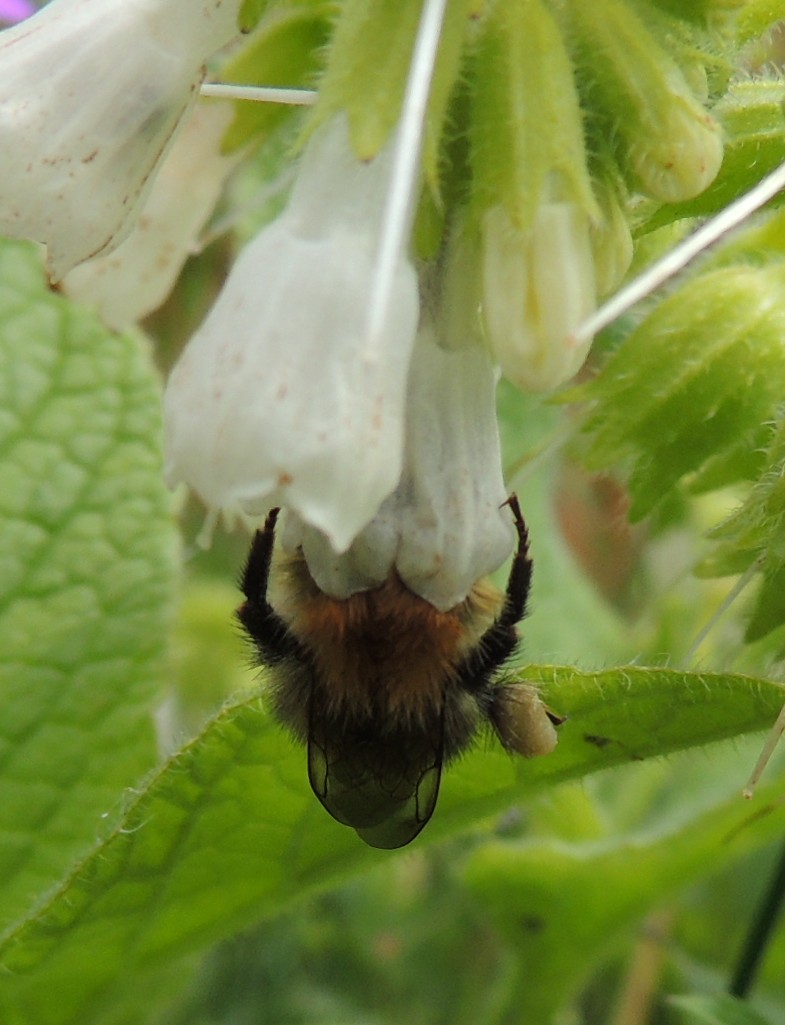
The colony behind the visitor
Where the food goes depends on which bumblebee we are watching. The Bumblebee Conservation Trust recognises 24 species in the UK. Eighteen are social species whose queens establish nests and raise workers. The other six are cuckoo bumblebees, which use colonies founded by other bumblebees to raise their young. That is already rather more variety than the usual yellow-and-black picture suggests. [1]
Some are mostly ginger. Others have a red tail or a sharply white one. The positions of the coloured bands matter, as do the face, body shape and sex of the bee. A typical tree bumblebee has a ginger thorax, black abdomen and white tail. The common carder is also ginger on top, but does not have that distinct white tail. Looking at the whole animal gives us a better chance than naming it from one passing flash of colour. [2]
There are awkward cases. Buff-tailed and white-tailed workers can be difficult to separate, and the white-tailed group itself includes closely similar species. A photograph may preserve a useful view, but it cannot supply a feature hidden on the other side. There is nothing wrong with recording a bumblebee without giving it a species name we cannot support. [2]
The question of which are solitary needs a different distinction. A social bee often feeds alone. That does not make it a solitary species. In the usual biological sense, a solitary female bee makes and provisions her own nest without a worker force. Britain has many such bees, including mining bees and leafcutters. Our bumblebees follow the social or cuckoo ways of life instead. A queen beginning her nest alone is at the first stage of a social colony. [1, 3]
For most British social bumblebees, the colony begins in spring with a queen that has survived winter in shelter. She needs food before she can establish a nest. Depending on the species, a suitable place might be an old rodent burrow, tangled grass or an above-ground cavity. A bird box can become a bumblebee address without anyone consulting its label. [3, 4]
Inside, she makes a small wax pot for nectar and prepares pollen for her developing offspring. She lays eggs and tends the brood, warming it with heat from her flight muscles. During this early period, the demands of the nest and the need to leave it for food fall on the same bee. [4]
The first adult offspring are female workers. As they take on foraging and other duties, the queen can remain in the nest producing further brood. A worker coming to our flowers may therefore be gathering food for animals we will never see. Later, a successful colony produces males and new queens. Males leave to find mates and do not return to provision the nest. [3, 4, 7]
The usual colony lasts a season. The old queen and workers die, as do the males. Newly mated queens carry the next generation through winter. Bumblebees do keep small food stores, but their annual cycle differs from that of a honeybee colony surviving winter together on a substantial reserve. [3, 4]
There are exceptions to the familiar calendar. Winter-active buff-tailed bumblebees have been recorded in Britain, particularly in milder urban places with winter flowers. A bee visiting mahonia in January need not have woken at the wrong moment. The date is useful context, rather than a complete explanation of its life. [5]
Cuckoo bumblebees depend on the work of these social colonies. A female enters an established host nest and lays eggs whose offspring are reared by the host workers. Cuckoo species produce females and males, without a worker caste of their own. They visit flowers to feed themselves, but do not gather pollen loads to provide for a nest. Their independence from foraging duties comes with a close dependence on another bee species. [1, 6]
Different flowers offer different ways in
Back among the flowers, the bee’s options depend partly on its tongue. The garden bumblebee, Bombus hortorum, has a particularly long tongue and visits deep flowers such as foxglove and honeysuckle. The Bees, Wasps and Ants Recording Society also describes its strong preference for red clover when that is available, although it visits a wider range of plants. A preference still leaves room for alternatives. [10]
Flower shape matters as much as whether a plant happens to be in bloom. An open flower offers a different approach from a narrow tube with nectar at the far end. Across the season, clovers, flowering trees, herbs and many garden plants can all contribute food. A useful garden offers several flower shapes and a succession of flowering periods, so that one brief abundance is followed by something else. [11]
There is another way of obtaining pollen that we can sometimes hear. On flowers such as tomatoes, a bumblebee grips the pollen-bearing parts and vibrates them using its flight muscles. The vibration releases pollen through small openings in the anthers. This behaviour is known as buzz pollination. The bee can do it while its wings remain folded. [12]
Calling it pollination can obscure the immediate action: the bee is extracting pollen. Whether pollen also reaches a receptive stigma is a further part of the encounter. An especially loud bee is not necessarily doing this, either. The sound is informative when we can connect it to the flower and the movements we are watching.
Some visits take a shortcut. A bee may reach nectar through a hole in a flower instead of entering through its opening. Naturalists call this nectar robbing because the visitor can obtain the reward while avoiding the usual contact with the reproductive parts. Darwin described such holes and visits in his observations of flowers. It is a reminder that feeding and successful pollination do not always accompany one another. [13]
How far the journey goes
On 29 May 2009, migration watchers at Bradford recorded an estimated 2,000 bumblebee queens moving westwards. Thijs Fijen brought this and other passage records together in a paper published in 2021. The garden visitor belongs to a group capable of large directional movements, as well as journeys between a nest and its feeding places. [14]
Those are different kinds of travel. A queen moving to a new area is not making the same journey as a worker carrying pollen home. The migration counts do not tell us how far each queen flew. Nor do they supply a feeding radius: the distance from a nest to a food patch is different again from the total route flown while collecting.
For the bee crossing our garden, the nest may remain out of sight. Its next choice of flower is easier to follow.
Returning to the same kind of flower
Watch a bee move across a mixed patch and a pattern may emerge. It visits one kind of flower several times, passing other kinds on the way. This is flower constancy: an individual concentrating on one flower species during a run of visits. It does not mean that the bee will feed from that plant for its whole life. A bumblebee species can use many plants even when one individual temporarily concentrates on one. [9]
We should also separate constancy from a routine. Returning to the same place, following a repeated route, choosing the same flower species and arriving at a similar time are different patterns. One can occur without all the others. Seeing a bee on lavender at lunchtime twice does not yet establish either its identity or a timetable.
The observation itself is old. In his 1876 book on the fertilisation of plants, Darwin discussed insects repeatedly visiting the same kinds of flower. He also recorded exceptions. Bees in his garden moved between differently coloured varieties of some plants, and sometimes between different species. His account is more interesting than an absolute rule because the animals do not behave identically on every occasion. [13]
Darwin proposed that familiarity with a flower might help an insect obtain its food more readily. That remains an intelligible possibility: a foxglove and an open bloom present different physical tasks. Repeating one task could have advantages for the visitor. [13]
Flower constancy is still a research subject. Christoph Grüter’s 2026 review considers the behaviour from the perspectives of pollinators and plants, including the question of why a visitor remains with one flower type. [15]
For the plant, repeated visits within the same species can make a useful difference. Pollen carried from a clover flower has a more promising destination on another compatible clover flower than on a foxglove. Constancy can therefore help bring together the plant’s reproductive needs and the bee’s food gathering. Whether the bee understands that consequence is the question the visible pattern leaves us with. [9, 16]
Does the bee place the pollen
In the physical sense, a bee can deliver pollen directly to the flower’s receiving surface. Pollen is produced in the anthers. The receiving surface is the stigma, often sticky. As a bee moves into or across a bloom, its body may touch the anthers and pick up grains. On a later visit, a pollen-bearing part of its body may brush a stigma and leave some behind. [16, 17]
Flower structure helps determine where those contacts happen. A narrow entrance can bring a visitor close to particular reproductive parts; an open flower offers other positions and movements. Kew photographer Heather Angel describes flowers whose structures deposit pollen on particular parts of visiting insects. The exact fit varies with the plant and visitor. [18]
So pollen transfer does not require the bee to stop and sprinkle a little from its baskets. Those packed loads are chiefly destined for food. Body contact can transfer loose pollen while the bee is occupied with feeding. Describing this as incidental refers to the relationship between the food-seeking action and its pollinating effect. It does not mean that the bee’s movements are aimless. [9, 16]
Pollination is the arrival of pollen at a stigma. Fertilisation is a later process, if the pollen is compatible and the necessary conditions are met. Seeds may then develop. A photograph of a bee on a flower captures one moment in that sequence; it cannot tell us the eventual outcome. [16, 17]
The word “places” leaves us with a question about purpose. The bee’s body can put pollen onto a stigma. Is that an effect it understands, or an outcome of movements directed towards food?
What would awareness mean
Our original question deserves more than a quick appeal to instinct. Attending to a flower and directing movements towards food are not the same claim as understanding that pollen deposited now can help a plant reproduce later. The sources considered here do not establish that bumblebees understand pollination. Flower constancy alone cannot decide it: familiarity or attraction to a rewarding plant could also account for repeated visits. Evidence for awareness would need to distinguish that explanation from the alternatives.
Nor would awareness have to resemble a person reciting a botany lesson. If we make the question depend on human language, we have made it unnecessarily narrow. We might instead ask what relationship between the bee’s actions and their later consequences would give us reason to think it recognises that connection. That is a question about evidence, as well as about what we mean by knowing.
There is a further distinction worth keeping. Knowing an effect and acting for someone else’s benefit are different things. Even if a bee were aware of an effect on a plant, it would not follow that helping the plant was its purpose. The flower may gain something from the visit without the bee having come on its behalf.
The flowers around the bee
The bee’s life also depends on things less conspicuous than the bloom it has chosen. A colony needs food across its active season, somewhere to nest and, for the next generation of queens, somewhere to survive winter. Removing flowers between mowing rounds or tidying every patch of rough vegetation changes what is available. A garden can provide both flowers and undisturbed places without being arranged entirely around bees. [3, 11]
Knowing the names helps, but watching is useful before identification becomes confident. We can note the date, the plant and the order of visits. We can distinguish a visible pollen load from an assumption that the bee is collecting pollen. Repeated records can become part of a wider picture through schemes such as the Bumblebee Conservation Trust’s BeeWalk, which brings observations from fixed walking routes together over time. [19]
There is room for a less organised encounter as well. A few minutes beside a flower may reveal the bee’s tongue, a change in the buzz, or the moment its back touches a part of the flower we had overlooked.
Then it lifts off. A little of what it collected may go home. A little may remain on the next flower.
Further reading
The Bumblebee Conservation Trust’s beginners’ pages and species guide are useful companions for recognising visitors and understanding their lives. Its gardening pages follow the practical question of providing flowers through the seasons. See references 1, 2 and 11 below.
The Bees, Wasps and Ants Recording Society offers species accounts with flowering preferences, distribution and seasonal information [10]. Darwin’s chapter on insects visiting flowers provides a historical account of flower constancy and the questions it prompted [13]. The numbered references below give the public sources for this article.
Photograph credits
1. Common carder bumblebee on clover in France, 20 July 2012. Llann Wé², W0154 Bombus pascuorum 49700.jpg, Wikimedia Commons. CC BY-SA 3.0. Reproduced without cropping or alteration; scaled for the page. Source https://commons.wikimedia.org/wiki/File:W0154_Bombus_pascuorum_49700.jpg. Licence https://creativecommons.org/licenses/by-sa/3.0/.

2. Bumblebee on comfrey, Sandy, Bedfordshire, 2 June 2013. Orangeaurochs, via Wikimedia Commons. CC BY 2.0. The photographer’s species identification is tentative. Reproduced without cropping or alteration; scaled for the page. Source https://commons.wikimedia.org/wiki/File:Bumblebee_(Bombus_pascuorum%3F)_on_comfrey,_Sandy,_Bedfordshire_(8927491709).jpg. Licence https://creativecommons.org/licenses/by/2.0/.

References
1. Bumblebee Conservation Trust — About bumblebees
https://www.bumblebeeconservation.org/learn-about-bumblebees/beginners/about-bumblebees/
2. Bumblebee Conservation Trust — Identification and species accounts
https://www.bumblebeeconservation.org/learn-about-bumblebees/identifying-bumblebees/
https://www.bumblebeeconservation.org/learn-about-bumblebees/species-guide/tree-bumblebee/
https://www.bumblebeeconservation.org/learn-about-bumblebees/species-guide/common-carder-bee/
https://www.bumblebeeconservation.org/learn-about-bumblebees/species-guide/white-tailed-bumblebee/
3. Royal Horticultural Society — Bees in your garden
https://www.rhs.org.uk/wildlife/garden-bees
4. Bumblebee Conservation Trust — The bumblebee lifecycle
https://www.bumblebeeconservation.org/learn-about-bumblebees/beginners/lifecycle/
5. Bumblebee Conservation Trust — Winter active bumblebees
https://www.bumblebeeconservation.org/news/winter-active-bumblebees/
6. Bumblebee Conservation Trust — The six cuckoo bees
7. Miranda Shephard and the Bumblebee Conservation Trust — How to help bumblebees in summer
https://www.bumblebeeconservation.org/news/how-to-help-bumblebees-in-summer/
8. Penn State Extension — The Bumble Bee Lifestyle
https://extension.psu.edu/the-bumble-bee-lifestyle
9. Natural History Museum — Seven insect heroes of pollination
https://www.nhm.ac.uk/discover/insect-pollination.html
10. M Edwards for BWARS — Bombus hortorum
https://bwars.com/bee/apidae/bombus-hortorum
11. Bumblebee Conservation Trust — Gardening for bumblebees
https://www.bumblebeeconservation.org/gardening/
12. Bumblebee Conservation Trust — What is buzz pollination
https://www.bumblebeeconservation.org/learn-about-bumblebees/faqs/what-is-buzz-pollination/
13. Charles Darwin — The Effects of Cross and Self Fertilisation in the Vegetable Kingdom
14. Thijs P M Fijen — Mass-migrating bumblebees
https://doi.org/10.1111/1365-2664.13768
15. Christoph Grüter — Flower constancy in pollinators
https://doi.org/10.1098/rspb.2025.2103
16. Australian Museum — Pollination
https://australian.museum/learn/animals/insects/pollination/
17. Royal Horticultural Society — Parts of flowering plants
18. Heather Angel for Royal Botanic Gardens Kew — Pollinators take their pick
https://www.kew.org/read-and-watch/pollinators-take-their-pick
19. Bumblebee Conservation Trust — Bumblebee surveying and monitoring
https://www.bumblebeeconservation.org/how-you-can-help/bumblebee-surveying-monitoring/