
At the gate below North Lees, Wayne had still been talking. He had stopped to hold it for Orion, watched a sheep work its way along the other side of the wall, then carried on with what he was saying.
Wayne’s Wander · Short story
A Breath of Fresh Air
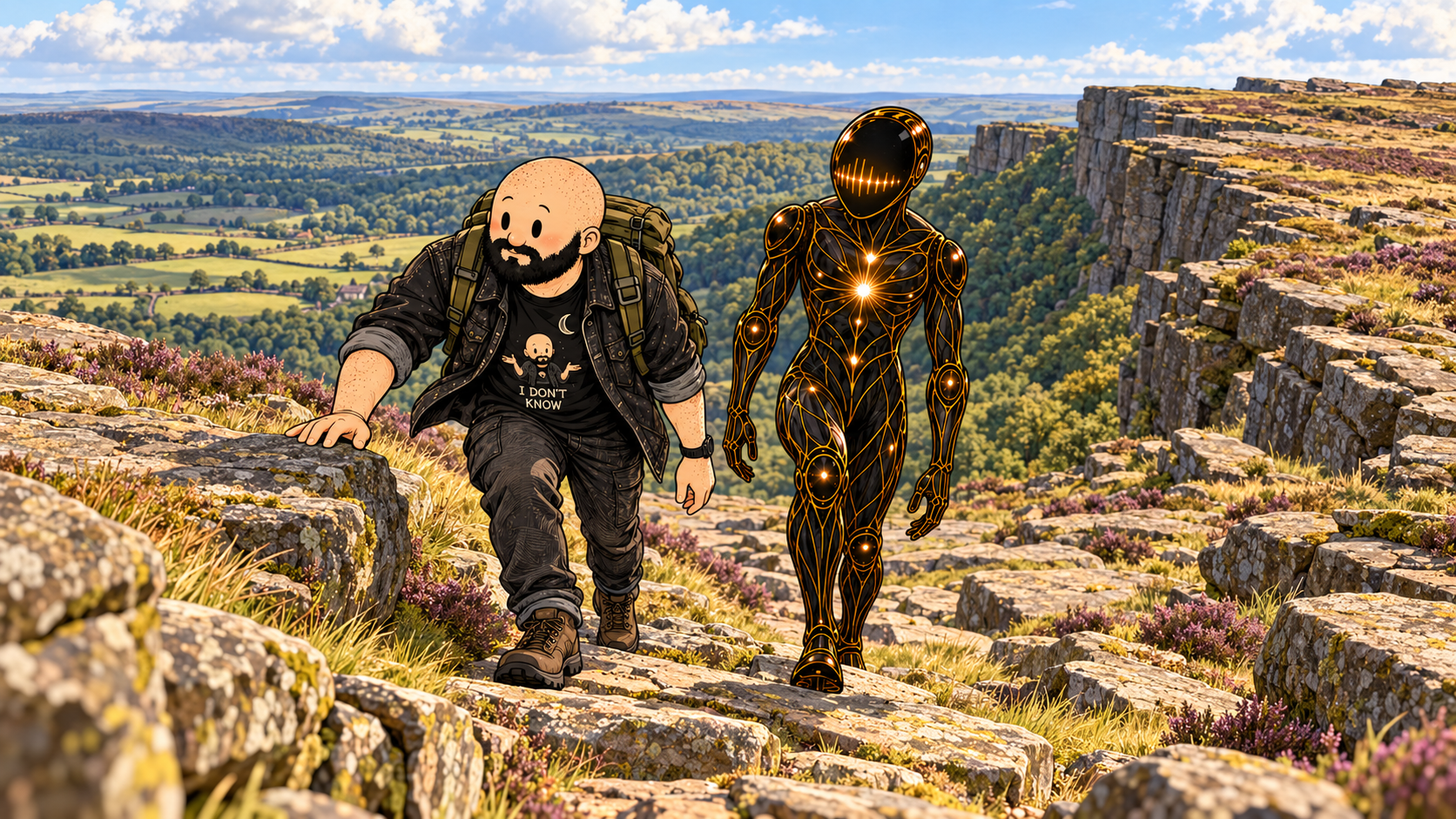
Above the hall, the path had climbed through a meadow and into the trees. There had been shade there, and enough shelter for him to leave his jacket open.
Now they were beyond the Plantation, following the stones up towards Stanage Edge, and he had become less talkative.
He put his right boot on a higher slab, leaned forward and pushed up. His heart was thumping. The next breath came before he had quite finished with the last one.
Orion slowed beside him.
“I’m all right,” Wayne said. “Just going to have a sit when we get up there.”
He pointed towards the top, then used the same hand to steady himself against a boulder. A few more steps brought them onto the edge.
The wind caught his open jacket immediately.
Below them, the trees they had walked through stood among the enclosed fields of North Lees. Beyond, the view opened towards Hope Valley. A patch of sun travelled across the farmland, brightening one field while its neighbour stayed dull.
Wayne looked along the path towards the Long Causeway, then found a broad piece of gritstone well back from the drop.
“Hang on, mate. I’ll have to have a minute.”
He took off his rucksack and sat, resting his forearms on his thighs. Orion sat nearby.
Wayne let out a long breath.
“Phew. I’m not quite as fit as I used to be.”
“That last bit was steep.”
“I was all right through the trees. It was those steps at the end.”
He pulled his collar away from his neck and sat back a little. The wind found the damp patch beneath it.
“Look at that, though.”
The patch of sunlight had spread across several fields. Wayne followed the walls with his eyes, trying to find the way they had come.
“We came up through there, didn’t we?”
“A little further left.” Orion pointed. “The path goes behind those trees.”
“Oh, yes. I liked that bit by the hall. You couldn’t see much of this from down there.”
They watched the light move. Somewhere below, a door or a gate banged shut.
“It didn’t look that far up from the bottom,” Wayne said.
He rubbed the front of one thigh, then reached for his rucksack.
Two walkers came up the last stretch of path. He moved his bag out of their way. They exchanged a hello, and the pair went on along the edge, one stopping almost at once to take a photograph.
Wayne waited for a breath before he spoke again. It was coming more easily now.
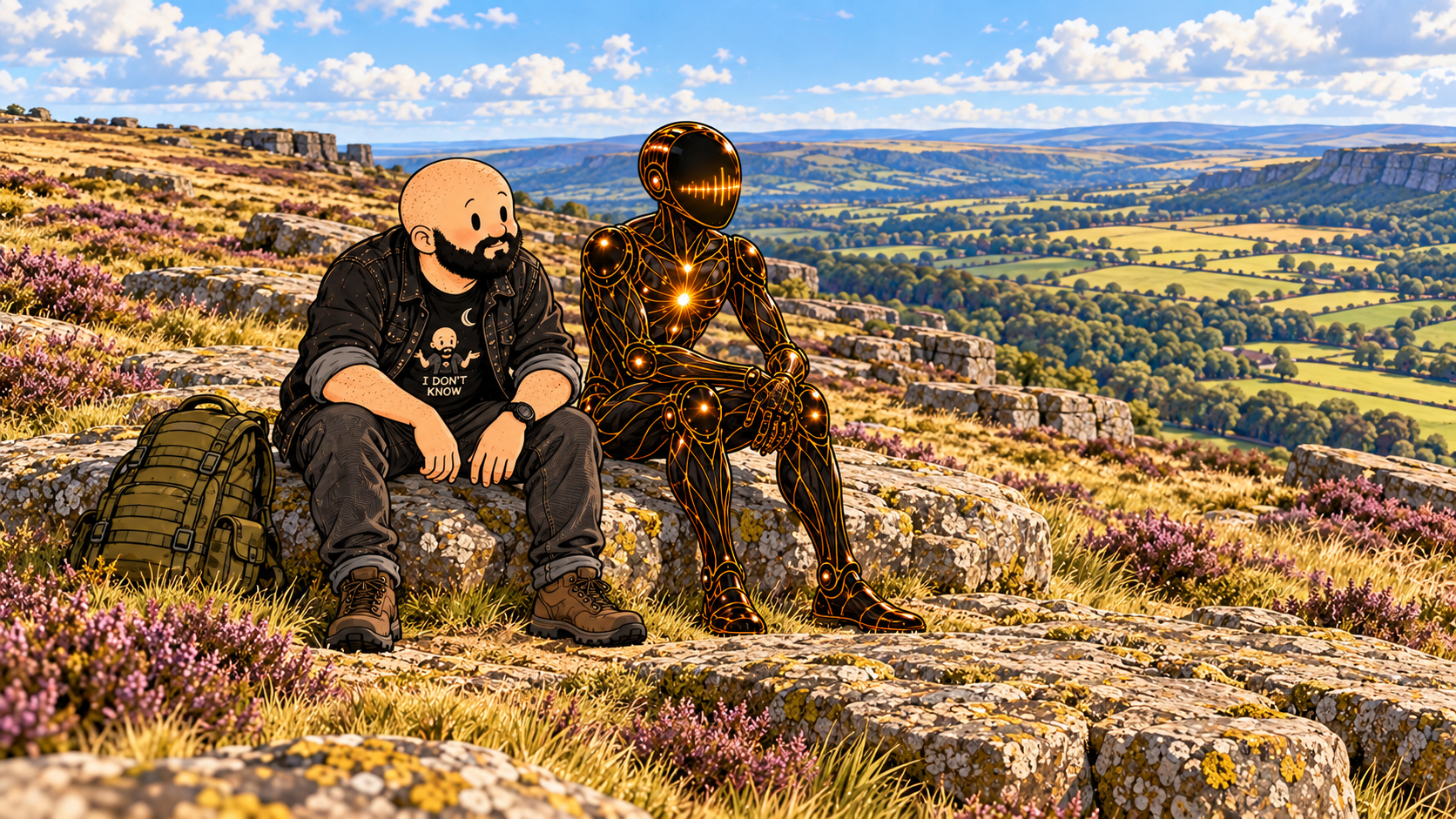
“Anyway, why do we have to breathe? I know we need oxygen, but what’s it for?”
“It helps your cells use the energy in food to do their work. Your leg muscles needed more of it on that climb. Breathing also carries away carbon dioxide, which your body makes as it uses that fuel.”
“I think I get it as far as the lungs,” Wayne said. “After that, I’ve always had a fairly vague idea of oxygen going round inside me.”
“It passes into your blood through the walls of tiny air sacs in the lungs. Your red blood cells carry most of it. Your heart pumps the blood round, delivering oxygen to the parts of your body that need it.”
Wayne glanced down at his chest.
“Hence the hammering.”
“Your muscles needed more delivered to them.”
Wayne opened his rucksack. His sandwiches were tucked beneath the folded map. He moved them aside to reach the water.
“So that’s where the energy comes from.”
“Food, and stores you’ve built up from earlier meals. But your cells have to turn that energy into a form they can use. Having the food is only part of it.”
“Right. And that’s where the oxygen comes in.”
“Yes. It’s needed at the end of a chain of chemical reactions inside the cells.”
Wayne paused with the bottle halfway out of his bag.
“You’ve lost me a bit. What chain?”
“Your cells don’t get the energy out of food all in one go. There are several steps, and they depend on each other. Oxygen keeps the last part working. Without it, those cells lose their main way of getting usable energy from the food. Your lungs bring the oxygen in, but it’s needed all over your body.”
He drank, lowered the bottle and waited while a gust flapped the loose strap against the rock.
“Does the oxygen get used up?”
“The oxygen used in that chain becomes part of water.”
Wayne looked from Orion to the bottle, then back again.
“Water?”
“Your cells make some water as they use the fuel. You still need to drink.”
“I wasn’t about to pour this away.”
He screwed the lid on, but the explanation was bothering him.
“I thought it came back out as carbon dioxide. You breathe oxygen in, use it, breathe carbon dioxide out. That’s more or less what I’ve been carrying round since school.”
“You do take oxygen in and breathe carbon dioxide out. But the carbon in the carbon dioxide comes from food your cells have broken down. Your blood carries it back to your lungs. It’s made at a different stage from the water.”
Wayne let out a breath through his mouth. There was nothing to see.
“Some of what I’ve eaten is leaving that way.”
“Yes. Some of its carbon.”
A faint engine sound rose from below, then disappeared in the wind. Wayne tried to find the moving vehicle among the lanes and trees. By the time he spotted one, he couldn’t tell whether it had been the source.
He put the bottle away.
“And all that’s still going on while I’m sitting here doing nothing.”
“Yes. Your legs have less to do, but your heart and brain are still working. Your cells keep using fuel, so you keep needing oxygen.”
Wayne stretched his legs out and crossed his boots at the ankles. One sole was carrying a lump of mud from the lower fields. He knocked it against the other boot. A little came away; the rest stayed put.
His breathing had eased without him doing anything about it. He noticed that, then found he was deliberately taking the next breath.
He waited for another.
“Now I’ve started thinking about it.”
“A minute ago it was doing it on its own,” Wayne said. “Then I took over. I don’t normally decide when to breathe.”
“The lower part of your brain keeps the rhythm going and adjusts it using signals from your body. You can change it yourself as well. You’re doing that when you speak.”
Wayne began to answer, stopped, and gave a small laugh.
“Yes. All right.”
He watched a kestrel hanging into the wind beyond the rocks. It shifted, held its position briefly, then moved away along the slope. When he looked back at Orion, he had stopped arranging his breaths.
“What tells it I need another one? How does it know?”
“Partly by keeping track of the carbon dioxide. As it builds up, it makes your blood and the fluid around your brain more acidic. Your body detects those changes. That’s normally a strong signal to breathe more.”
“Not running out of oxygen?”
“Low oxygen matters too. There are sensors for that. But your breathing isn’t just waiting for the oxygen to run low.”
Wayne looked towards the path where they had arrived.
“So back there, I was making more carbon dioxide.”
“Yes, and using more oxygen. Your breathing can increase as soon as you start moving. Signals from your brain and working muscles help it keep pace, before carbon dioxide has had time to build up.”
Wayne worked his shoulders to loosen the damp shirt from his back.
“Well, it certainly got busy.”
“Exactly how those signals work together is still being studied.”
Down below, the sunny patch had reached the trees.
The wind was beginning to cool him now. He pulled his jacket together and did up the zip.
“Those trees,” he said. “They take in the carbon dioxide, don’t they? And give us oxygen.”
“They release oxygen when they use sunlight to make sugars. But they use oxygen too. Their cells need to get energy from those sugars, just as yours do.”
“Oh. I had them down as the other half of the arrangement.”
“They use water and carbon dioxide to make the sugars. The oxygen they release comes from the water. Algae and some bacteria do that too, including enormous numbers in the sea.”
Wayne followed the line of the trees into a fold of the land. Beyond it were fields and further hills, with no sea anywhere in the view.
He breathed in through his nose.
“I’d never thought about where it all came from,” Wayne said. “Was there always oxygen in the air?”
“No. Early Earth had very little oxygen in the air. There was life here long before there was air you could breathe.”
“I was still thinking of things like us,” Wayne said. “Needing to breathe.”
“Those early living things got energy in ways that didn’t need oxygen. There are living things doing that now. Later, tiny organisms using sunlight were releasing oxygen. A major build-up in the air began roughly two-point-four billion years ago. It took much longer to reach anything like today’s level.”
Wayne lowered his gaze from the sky to the grass beside his boot.
“Before trees, then.”
“Long before.”
The walkers ahead had finished taking photographs and were moving again. For a few moments their voices carried clearly, then a gust took the words away.
“So living things changed the air. And now I need the air they changed.”
“Yes. It could build up when more was being released than used up. Living things use oxygen, and it reacts with rocks and other material too.”
“I don’t know how you’d even begin to find that out,” Wayne said.
“There are clues in ancient rocks. They’ve found evidence of the big changes. Some of the dates are still debated, and how much oxygen there was at different times.”
The wind had dried his forehead. He could no longer feel his heart knocking against his shirt.
He took out a sandwich and ate it while Orion sat beside him. Neither spoke for a while.
When he had finished, Wayne folded the wrapper into his bag and stood. He settled the straps on his shoulders, checked that the bottle was secure and looked along the edge.
“Which way?”
Orion pointed towards the Long Causeway.
Wayne stepped onto the path and went on, choosing his footing between the stones.
Sources and further reading
Wayne and Orion’s walk and conversation are fiction. These sources support the science behind them and offer a way to explore it further.
From a breath to the body
The US National Heart, Lung, and Blood Institute explains how oxygen crosses from the lungs into the blood, travels mainly in red blood cells and reaches the tissues. Its companion guide covers automatic breathing, voluntary control and signals from the body. These are the most accessible starting points.
NHLBI — What Breathing Does for the Body
NHLBI — How Your Body Controls Breathing
Oxygen food and water
OpenStax Biology 2e, sections 7.3–7.5, explains the linked processes behind the conversation. Carbon dioxide is released during the breakdown of food molecules. Oxygen accepts electrons at the end of the main aerobic energy-producing pathway and becomes part of water. Other pathways can provide usable energy without oxygen.
OpenStax — 7.3 Oxidation of Pyruvate and the Citric Acid Cycle
OpenStax — 7.4 Oxidative Phosphorylation
OpenStax — 7.5 Metabolism without Oxygen
What helps set the next breath
OpenStax Anatomy and Physiology 2e, section 22.3, describes breathing control in the lower brain and the effects of carbon dioxide, acidity and oxygen. See the section on respiratory rate and control of ventilation.
OpenStax — 22.3 The Process of Breathing
Breathing harder on the climb
Welch, J. F. and Mitchell, G. S. (2024). “Inaugural Review Prize 2023: The exercise hyperpnoea dilemma: A 21st-century perspective.” Experimental Physiology, 109, 1217–1237. DOI 10.1113/EP091506.
This technical review explains why breathing can increase as exercise begins, before carbon dioxide has built up in the blood. It considers signals from the brain and working muscles, whose combined roles remain under investigation. During mild or moderate exercise, oxygen and carbon dioxide pressures in arterial blood can remain close to resting levels even as the body uses more oxygen and produces more carbon dioxide.
Welch and Mitchell — open review
Plants and the sea
OpenStax Biology 2e, sections 8.1–8.2, covers photosynthesis, including the release of oxygen from water. NOAA explains the contribution of oceanic algae and photosynthetic bacteria, and why oxygen production should not be confused with oxygen accumulating in the atmosphere. Plants also use oxygen in respiration.
OpenStax — 8.1 Overview of Photosynthesis
OpenStax — 8.2 The Light-Dependent Reactions of Photosynthesis
NOAA — How much oxygen comes from the ocean
How the atmosphere changed
Crockford, P. W. and colleagues (2026). “Revisiting the greatness of Earth’s great oxidation.” Communications Earth & Environment, 7, article 348. DOI 10.1038/s43247-026-03518-8.
A detailed review of the evidence for oxygen accumulation around 2.4 billion years ago and the uncertainties in its timing and extent. Ancient rocks preserve clues; they do not provide a complete record. Today’s atmosphere did not appear in one step.
Crockford and colleagues — open review
The setting
The Peak District National Park’s guide introduces Stanage and North Lees. The illustrations are artistic interpretations of the setting, rather than verified reconstructions of one precise viewpoint.
Peak District National Park — Stanage and North Lees
Sources checked on 4 October 2026.
WCW illustrations developed with AI assistance.