Part One
Wayne’s Wander · A story in two parts
A Loveliness of Ladybirds

Wayne had cleared enough of the path to get the wheelbarrow through. Unfortunately, the wheelbarrow was now in the bit he wanted to clear next.
He stood with an armful of cut stems and looked at it.
“Could you move that back a bit, mate?”
Orion took the handles. Wayne dropped the stems in, then pulled a long piece back out before it caught on the rose.
“That'll do. Cheers.”
The September sun had reached the fence, though the ground beneath the plants was still damp. A robin landed on the low wall behind him. Wayne went back to cutting the collapsed growth away from the edge of the paving. Further into the border, the tall seedheads could stay where they were.
He had been stepping over a loop of clematis all summer. Now, with the plants in front out of the way, he could see where it had slipped from its support. He put the secateurs down and lifted it gently.
Something black and orange was walking along the underside of a leaf.
Wayne stopped moving the stem.
“Come and have a look at this.”
The little creature reached the edge, raised the front of its body and went round onto the upper surface. It had six legs near its head and a long, ridged body covered in short spikes.
“There are loads of them.”
He had seen three. Now he could see another on the next leaf, two further down and several among the stems against the fence.
Orion moved closer.
“Ladybird larvae. The larger ones with those orange markings look like harlequins.”
Wayne looked back at the one nearest his hand.
“That's going to be a ladybird?”
“Yes.”
“I'd never have put those two together.”
He brought the leaf a little nearer without touching the insect. There was nothing round or shiny about it. As he watched, it changed direction and disappeared underneath again.
“I thought they might be eating the clematis.”
“These eat aphids and other small insects. Have a look along that soft shoot.”
Wayne followed the shoot with his eyes. A few greenfly were crowded close to the tip.
“Oh, yes. I hadn't seen those.”
“They could help explain why the larvae are here. Harlequins use lots of different plants. It needn't be anything special about clematis.”
Wayne lowered the stem back towards the fence. Something orange remained fixed beneath another leaf. It was much shorter and rounder than the walking creatures, with dark patches across its back.
He found another just above it. Then four more.
“These aren't moving. Are they dead?”
“They're pupae. That's the stage after the larva, while the adult beetle is developing.”
“Like a chrysalis?”
“Yes, the same stage. We usually call a butterfly's pupa a chrysalis. With ladybirds, we say pupa.”
Wayne crouched to look underneath. At the base of the nearest one was a small, crumpled black fringe.
“It looks as if it's still got bits of the other thing stuck to it.”
“That's the old larval skin. They attach themselves before they shed it and become pupae. Some of the skin stays at the base.”
He stayed there for a moment. The insect was attached to a leaf barely wider than his thumb. From where he had been standing a minute earlier, he wouldn't have noticed it at all.
Behind him, the robin dropped onto the newly exposed ground. Wayne turned at the movement. It picked at something beside a root, then hopped beneath the rose.
“He's been waiting for me to get out of the way.”
He shifted his foot to give the bird room and nearly put his heel on the secateurs. He picked them up and laid them on the wall.
For a while they watched the robin working along the cleared strip. A hoverfly hung above the late daisies, moved sideways and settled on a flower. When Wayne turned back, sunlight had caught a web stretched between the clematis and the fence post. A brown spider sat near its centre, pale spots making a small cross on its back.
He had been about to pull that stem sideways.
“I'll tie it over here instead.”
Orion passed him the ball of soft garden twine from the wall. Wayne cut a length, checked the section he wanted to hold, then eased the loose growth towards the support. He kept the tie well away from the occupied leaves.
“I thought all this happened in spring,” he said. “The young ones, I mean. Not when I'm starting to put the garden to bed.”
“Harlequins can have more than one generation in a year. You can still find their larvae in autumn. How quickly they develop depends on conditions, including temperature and food.”
Wayne held the stem while he tried to get the two ends of the tie together.
“And the ones stuck to the leaves? They won't stay like that all winter?”
“Harlequins normally spend the winter as adult beetles. These still have to finish developing.”
“I'd quite like to see that.”
He made a loose knot, then checked that the stem wasn't being pinched. The loop no longer lay across the path.
“There. You can get past now.”
Orion brought the wheelbarrow through. Wayne stepped back to let him pass, then leaned towards the clematis once more.
The larva he had first noticed was out of sight. Another was working its way down towards a leaf joint. The orange pupae were still where he had found them.
He took his phone out and photographed the patch beside the fence post.
Then he collected his secateurs and went round to the other side of the border.
Part Two
October at the shed

By the time Wayne finished mowing, a fresh scattering of leaves had landed on the grass.
He stopped at the end of the last strip and looked back.
“That took them about thirty seconds.”
He wheeled the mower onto the path. It had been a mild October afternoon, dry enough to get the job done once the dew had cleared. Now the shadow of the house had reached halfway across the lawn.
Orion held the shed door while Wayne pushed the mower over the raised sill. A rear wheel caught. He lifted it over the sill and pushed the mower inside.
Inside, it smelt of cut grass and old timber. Wayne removed the battery, put it on the shelf by the door and straightened.
Three orange dots were moving along the window frame.
“Oh. Look at these.”
He bent closer. There were another dozen beneath the projecting edge. Further up, where the pale paint had peeled away from the wood, the dark line of a crack was crowded with small, rounded bodies.
“There's more in the top corner,” Orion said.
Ladybirds occupied the narrow recess between the frame and the wall.
“Blimey. I thought there were about six.”
Some were orange with black spots. Others were almost entirely black, with bright red patches. A few walked between those that had stopped.
He glanced through the window towards the clematis.
“Could these be our lot?”
“Some could be. Others may have flown in from elsewhere.”
“I kept looking, you know. At those things on the leaves. Then I went a few days without checking and most of them had gone.”
“You might find some empty pupal cases still attached.”
Wayne took out his phone and found the photograph. There were the orange shapes beneath the leaves, much easier to see on the screen when he enlarged them.
He looked from the picture to the rounded beetles above the window.
“They look so different.”
He put the phone away. An orange one crossed in front of a black one, stopped and turned back.
“Are those both harlequins, then?”
“They look like it. Harlequins come in several colours and patterns. Their size and the markings just behind the head help too. I can't identify everything tucked into that crack.”
Wayne began counting along the lower edge of the group. Two moved, and he lost his place.
“What do you call this lot? A swarm?”
“A gathering would do. They're sometimes called a loveliness.”
“A what?”
“A loveliness of ladybirds.”
Wayne smiled.
“That's nice. Somebody was in a good mood.”
For a while he watched a black one making its way up the side of the frame. It stopped beneath an orange beetle, turned and went round it.
“Who came up with that?”
“I’ve come across the name, but I don’t know who first used it.”
Wayne leaned back against the clear edge of the workbench.
“Well, I like it.”
Outside, something buzzed past the open door. The ivy over the fence was in flower, its small greenish heads busy with flies and a couple of wasps. Wayne could hear them now the mower had stopped.
“There's still plenty going on out there. Why are these coming in already?”
“They're looking for winter shelter. Harlequins often gather around buildings in autumn and work their way into gaps. As conditions get colder, they become much less active and live on reserves they've built up by feeding.”
Wayne looked along the crowded recess.
“So they're not doing what the ones on the leaves were doing.”
“No. These are already adults. They aren't going through another change into something else.”
“Right.”
He drew his hands into his sleeves. The sun was still on the outside wall, but the shed was cooling.
“I wouldn't fancy a winter in here.”
“Their needs are different from ours. Too much warmth can make them use their reserves faster, though severe cold is a problem too. Shelter matters.”
Wayne examined the rest of the frame. There were gaps all along it, most apparently empty.
“I still don't get why they're all in that bit. There are gaps everywhere.”
“Harlequins leave chemical traces on surfaces as they walk. Research suggests those can help others find and settle with a group once they're nearby.”
“On the wood?”
“Yes. That isn't the same as a smell drawing them from the far end of the garden. The appearance of a building can help bring them to it in the first place.”
Wayne followed an orange beetle with his eyes. It was coming round the side of the recess towards the others. It reached the edge of the gathering, turned away and disappeared behind the frame.
“Well, I've lost that one.”
He tried another angle, then gave up and stepped into the doorway.
A small gust moved through the ivy. The flies lifted and settled again. Beyond it, the clematis was still held clear of the path by the tie he had put in during September.
Wayne picked up the mower battery and checked that the handle was clear of the door. Then he eased the door shut and pressed the latch down with his thumb.
On his way back to the house, he stopped at the clematis and turned one of the leaves gently towards the light.
Sources and further reading
The garden and its encounters are fictional. The life stages and seasonal behaviour draw on the sources below. September larvae and October adults need not be the same individuals, and weather, location and species all affect what appears in a real garden.
The unfamiliar young
Ladybirds pass through larval and pupal stages before becoming adults. For pictures and identification details, the UK Ladybird Survey's harlequin account is a useful starting point. The Field Studies Council also publishes a guide devoted to larvae and pupae.
UK Ladybird Survey harlequin account
Field Studies Council ladybird larvae guide
Harlequins can have repeated generations in Britain, so young stages are not confined to spring. Roy and Brown's review brings together the British records and research. This supports the story's timing without establishing what happened on any particular clematis.
A garden that is still busy
The RHS September guide covers late flower visitors and the value of retained stems and seedheads. Its clematis guide explains why pruning depends on the type of plant.
Flowering ivy can provide autumn food for several kinds of insects. Garbuzov and Ratnieks studied its visitors in Sussex; the mix varied between sites and times.
The gathering at the window
UKCEH explains why harlequins and some other ladybirds enter buildings in autumn. Shelter and stored reserves matter during winter; a location comfortable for people is not automatically suitable for a beetle.
The chemical traces in Orion's explanation concern surfaces near a gathering. Durieux and colleagues' research does not show a scent drawing beetles from the far end of a garden, nor tell us what guided a particular individual.
Why a loveliness
The expression is in use, including in Sussex Wildlife Trust's writing. Its first coiner has not been established here. It is a pleasing collective name, not a technical biological category.
A closer look
These photographs show real ladybirds. They are separate observations, not photographs of the fictional garden and shed.
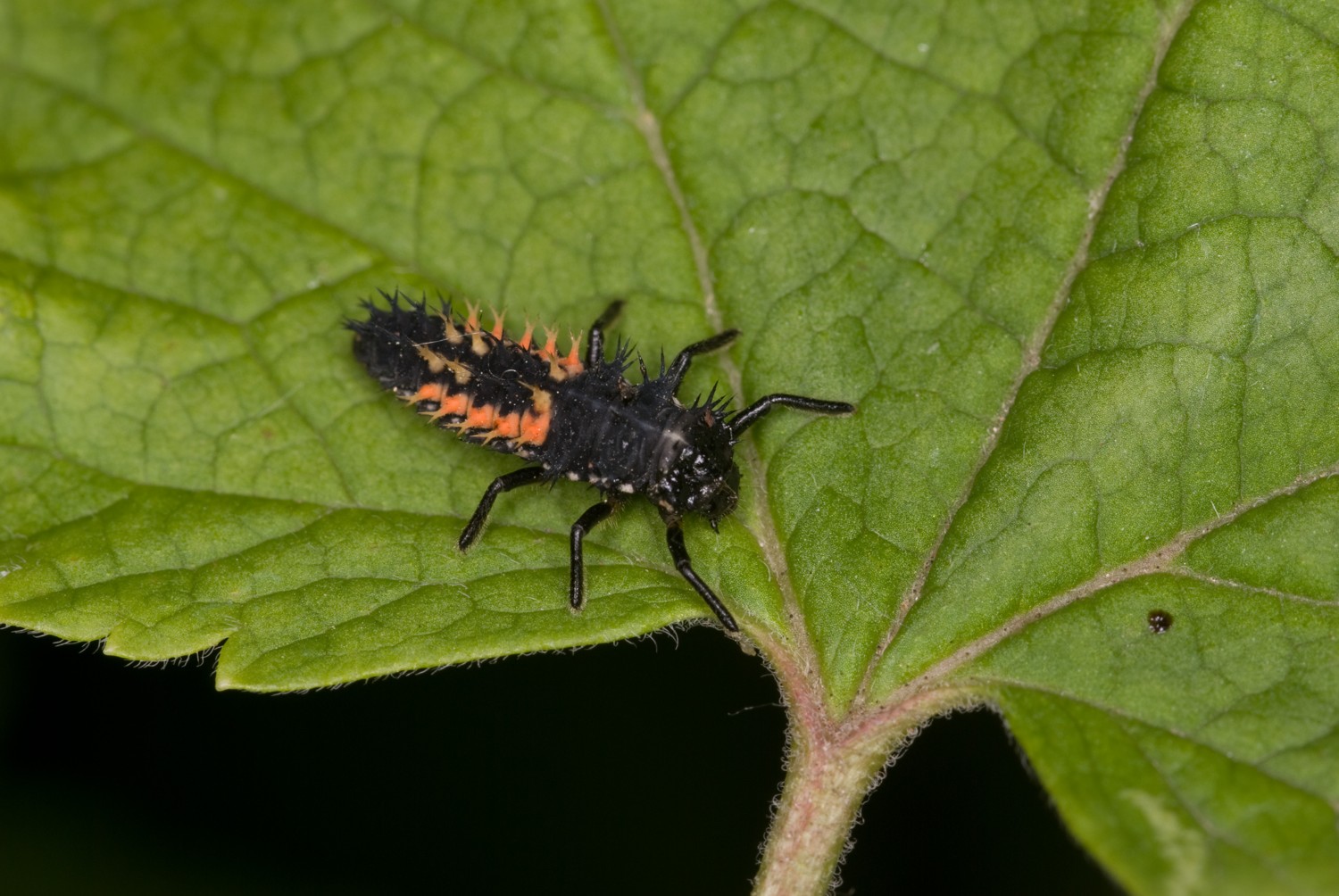
Harmonia axyridis larva-pjt.jpg — Pjt56, via Wikimedia Commons. CC BY-SA 3.0. Resized for this page; the photograph remains available under that licence.
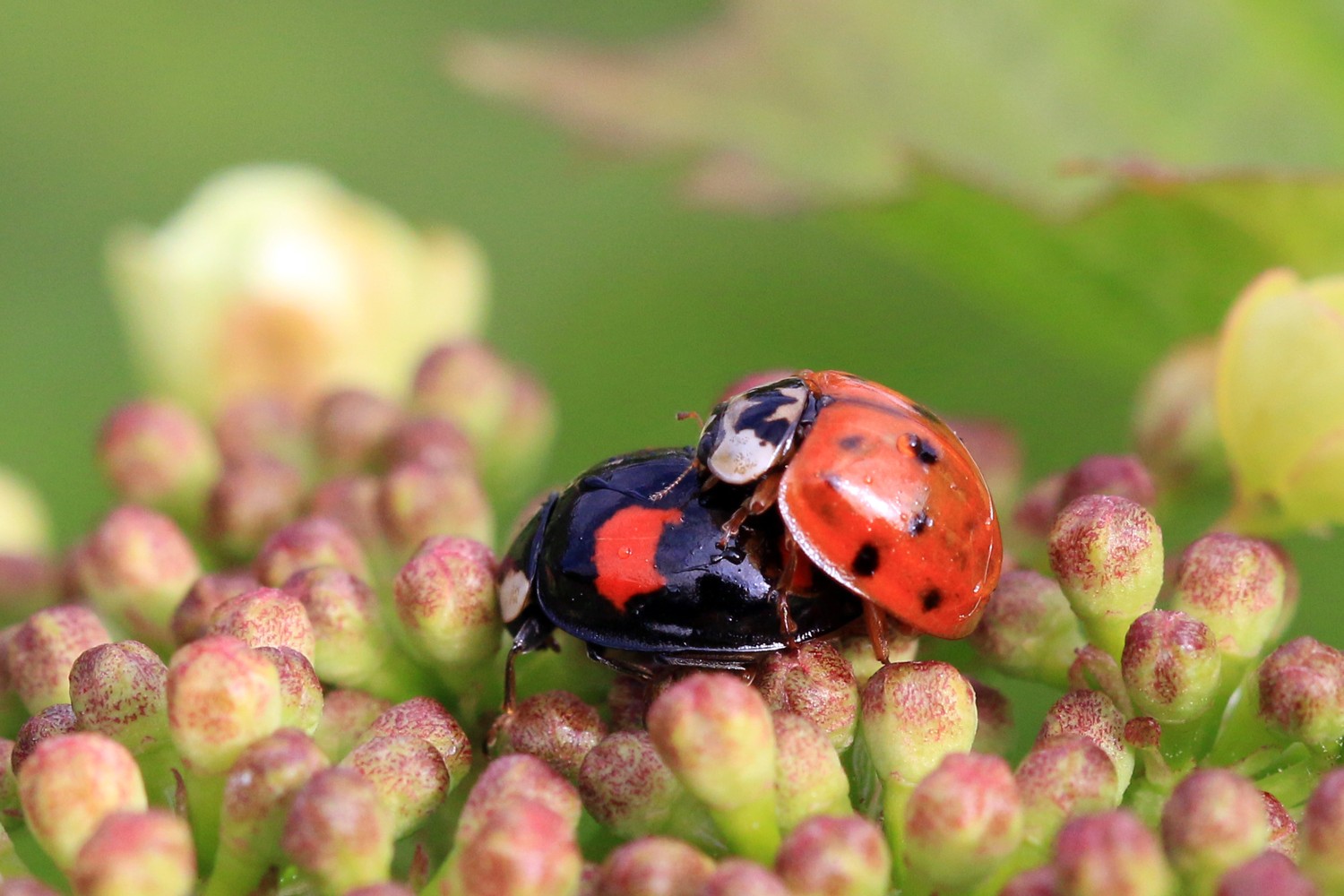
Harlequin ladybirds (Harmonia axyridis) mating.jpg — Charles J. Sharp / Sharp Photography, via Wikimedia Commons. CC BY-SA 3.0. Resized for this page; the photograph remains available under that licence.
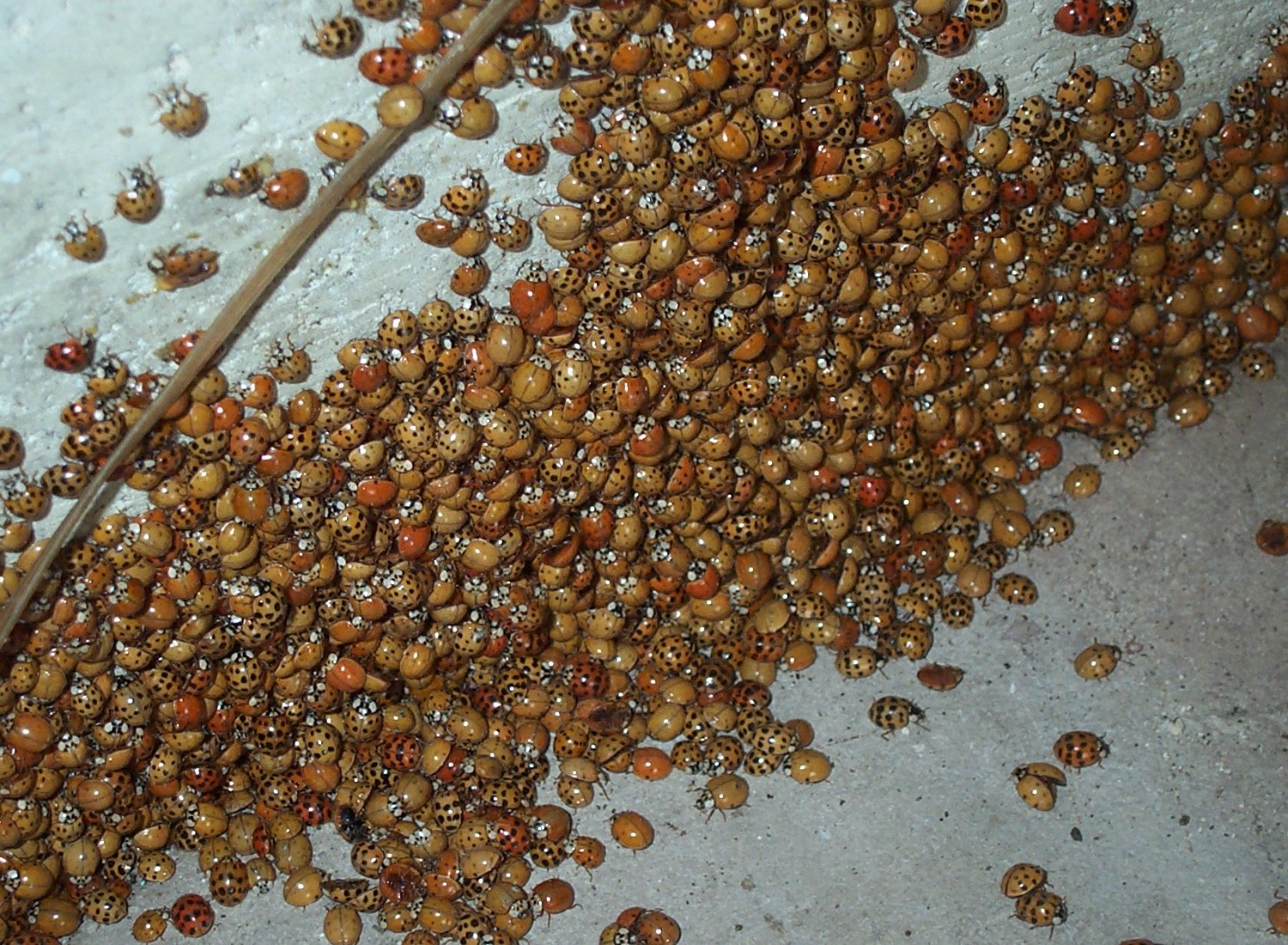
Asian Lady Beetle Cluster.jpg — Jared Birk, via Wikimedia Commons. CC BY-SA 3.0. Resized for this page; the photograph remains available under that licence.